
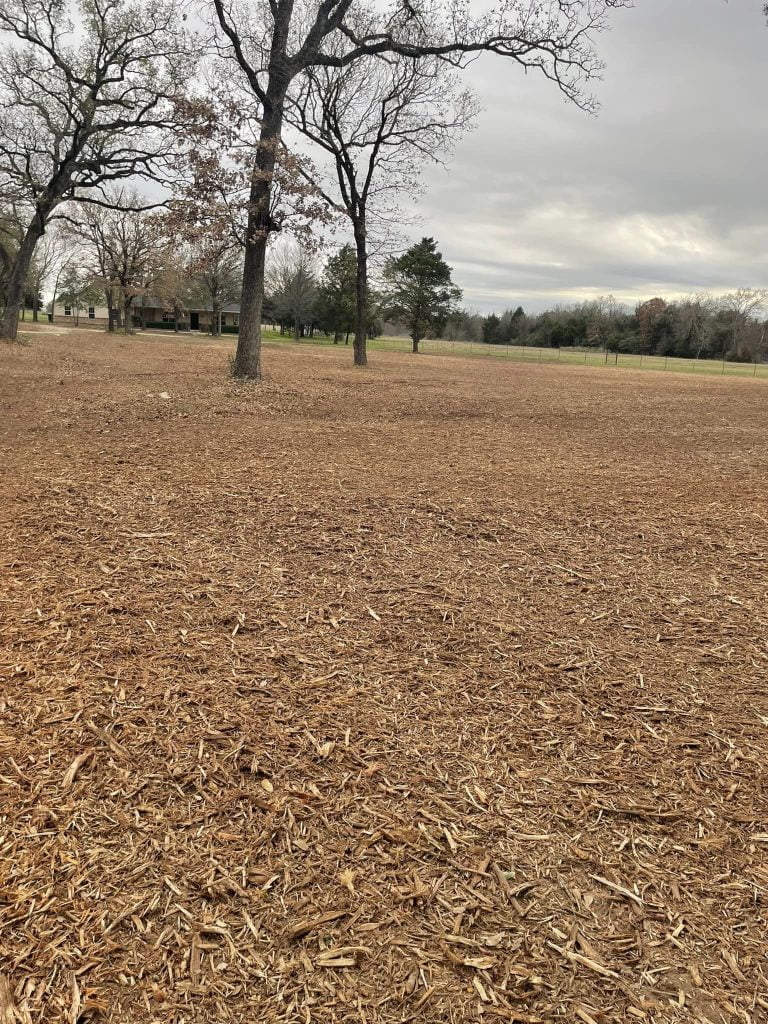
Mulching is one of the most practical and land-friendly ways to manage overgrown vegetation, reduce fire hazard, and maintain your property’s condition over time. Rather than hauling off brush and debris, a mulching machine grinds it down in place — returning organic material to the ground while leaving your land clean, accessible, and in better shape than you found it. 3T Brush Control provides mulching services throughout Streetman, Texas and the surrounding area.
What Land Mulching Does
When we mulch a piece of land, we’re using a forestry mulcher — a machine with a high-speed rotating drum of cutting teeth — to process trees, brush, stumps, and vegetation into a ground-covering layer of wood chips and organic material. The process is efficient, single-pass, and doesn’t require the land to be scraped bare or the debris to be hauled off a site.
The result is a layer of mulch on the ground that suppresses weed regrowth, reduces erosion, retains moisture, and breaks down into the soil over time. It’s a net positive for the land, not just a clearing method.
How Mulching Differs from Brush Clearing
Both services deal with unwanted vegetation, but they approach it differently. Brush Clearing can mean physically cutting and removing vegetation using various methods. Mulching specifically refers to grinding the material down and leaving it in place. For many rural and agricultural properties, mulching is the more efficient option — it moves faster, costs less in hauling, and benefits the soil.
The right approach depends on what you’re trying to accomplish. If you need the land completely bare for construction, mulching alone may not be the final step — that’s where Site Preparation picks up, taking the cleared land and getting the ground ready for a foundation, driveway, or build pad. If you’re managing a property, reclaiming pasture, or reducing fire hazard, mulching is often the most practical solution.
Benefits of Mulching for Rural Properties
Fire hazard reduction is one of the primary reasons landowners invest in mulching. Dry, dense brush in Texas summers is a serious fire risk. Mulching reduces the fuel load on a property by breaking it down into a form that doesn’t carry fire the same way standing brush does.
Mulching also makes land more manageable for the long term. Without the thick undergrowth, you can see across the property, access all areas, and keep an eye on what’s growing. Maintenance becomes far easier once the initial mulching is done.
For landowners who want to improve pasture quality, mulching removes competing brush so that grasses and forage plants have room to recover and grow without being shaded out or crowded. If the property also has a pond or water feature, mulching along the banks pairs well with our Pond Maintenance service, which addresses overgrowth, erosion, and vegetation management around the water’s edge. And for properties with trees that need trimming or selective removal alongside the mulching work, our Tree Trimming service handles that as part of the same overall land management effort.
For larger projects where mulching is the first step in a full land development plan, Dozer Work and Excavation are available to handle the grading, shaping, and digging that follow once the vegetation is cleared. If there are old structures on the property that need to come down as part of the cleanup, our Demolition service covers that before or alongside the mulching work.
Serving Streetman and the Surrounding Region
We work with landowners across Streetman and the surrounding 120-mile area, including Corsicana, Ennis, Athens, Palestine, Waco, and many communities between them. Mulching is a service we perform regularly across this region, and our team is experienced with the plant types and terrain common to East and Central Texas.
Ready to Get Started?
Call 3T Brush Control at (903) 390-0763 or contact us online to discuss your mulching project. We’ll give you a realistic picture of what the job involves and what to expect when it’s done.
Frequently Asked Questions — Mulching
What’s left on the ground after mulching?
A layer of shredded wood chips and organic material — sometimes described as woody mulch. The texture and depth depend on what was processed. It looks clean and natural, breaks down over time, and is far better for the ground than bare, scraped dirt.
Does mulching kill the roots of trees and brush?
Mulching removes the above-ground portion of vegetation, but it doesn’t always kill the roots. Some species — particularly cedar and certain shrubs — can regrow from the root system. This is worth discussing upfront, especially if you want to ensure long-term control of specific plants. Repeat maintenance treatments over time are often the most effective approach for aggressive regrowth.
Is mulching safe near a fence line?
Yes. We operate carefully around fence lines. A good operator can work right up to a fence without causing damage. Let us know where your fence lines are and any areas that need extra care.
How often should a property be mulched to stay manageable?
It depends on the vegetation type, rainfall, and your goals. Some properties are done once and maintained easily afterward. Others with aggressive regrowth species may benefit from maintenance mulching every few years. We can give you a realistic expectation for your specific situation.
Can mulching help with fire prevention?
Yes. Reducing the density of standing brush and replacing it with a ground-level mulch layer lowers the fuel load on a property and makes fire less likely to spread rapidly through it. This is one of the more common reasons landowners invest in mulching, particularly in rural Central and East Texas.
Will mulching work on cedar trees?
Yes. Cedar is one of the most common trees we mulch in this region. A forestry mulcher handles cedar efficiently. As noted above, cedar can resprout from the root, so follow-up treatment or monitoring may be needed depending on your goals.